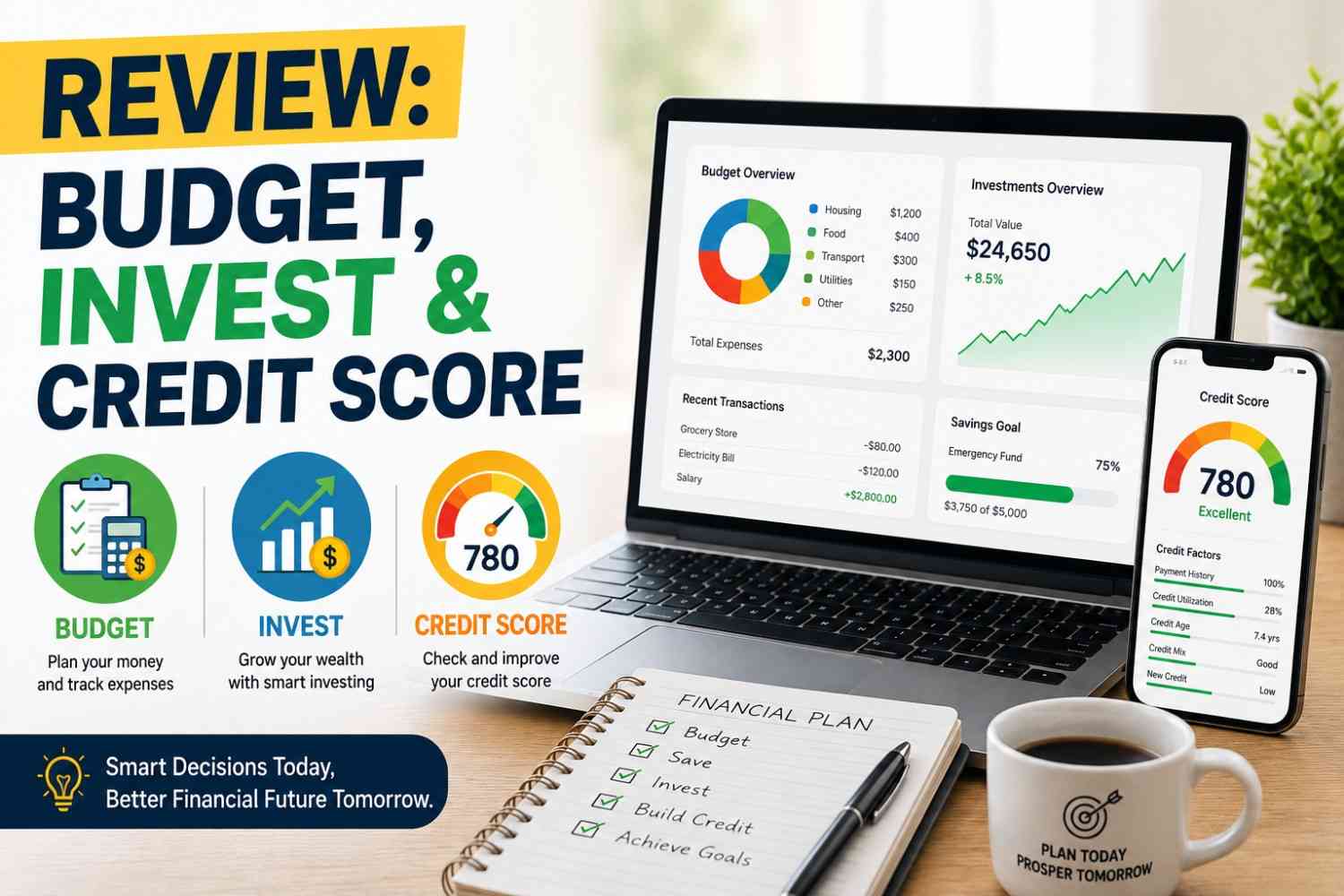
GoMyFinance was founded in 2024 with a mission to demystify finance and make it accessible to everyone. The platform covers a wide range of financial topics — from stocks and real estate to practical calculators — positioning itself as a companion for both novice investors and those seeking more advanced insights.
In plain terms, it’s a personal finance website. Not a bank. Not a brokerage. Not a credit union. Think of it more like a knowledgeable friend who explains financial concepts clearly and gives you tools to apply what you’ve learned.
The site is structured into three core areas: Personal Finance (articles on budgeting, debt management, and savings), Investors (market news and stock trend analysis), and Calculators & Tools (simple web-based tools for loan payments and retirement planning).
That structure makes it approachable. You’re not dropped into a complex trading interface. You start with what you need, and the platform guides you from there.
GoMyFinance.com Saving Money: 12 Smart Tips to Build Real Wealth in 2026
How the Platform Works
GoMyFinance works on a content-plus-tools model.
You visit the site, create a free account, and get access to educational articles, financial calculators, and a dashboard that helps you track goals. The dashboard displays an overview of your finances, plans, credit rating, and saving targets. Navigation is user-friendly — clicking any tab leads you to a detailed view covering budget, credit, invest, or tools.
The platform also connects with your bank accounts through third-party data aggregators. For its budgeting and tracking features, GoMyFinance uses secure third-party data aggregators like Plaid or Finicity to pull in your real-time transaction data.
This is the same approach used by Mint, Credit Karma, and most modern budgeting apps. You link your accounts once, and the platform begins categorizing your spending automatically.
GoMyFinance.com Saving Money: 12 Smart Tips to Build Real Wealth in 2026
Key Features Breakdown
Budget Tools: GoMyFinance.com Create Budget
One of the most used features on the platform is the budget creator.
The platform helps users understand their actual take-home income after taxes and deductions, list all expenses including fixed costs (rent, bills) and variable costs (groceries, entertainment), and set both short-term and long-term financial goals.
Short-term goals might include paying off a credit card or building a $1,000 emergency fund. Long-term goals might involve saving for a home down payment or retirement.
Spending categories and alerts make budgeting easier, helping users spot spending patterns or opportunities quickly.
The budget tool isn’t overly complex. You won’t find advanced envelope budgeting or zero-based budget automation here. But for someone starting out who simply needs to see where their money is going each month, it works well.
Practical tip: Set up weekly alerts after you create your budget. Most overspending happens gradually — a few extra takeout orders, some impulse purchases — and alerts catch it before it becomes a problem.
Investing Section: GoMyFinance.com Invest
The investing section allows users to explore different investment options such as stocks, bonds, and cryptocurrency. The platform includes learning materials that explain budgeting, saving, and investing in simple terms, which is especially helpful for beginners who want to understand financial basics.
For beginner investors, GoMyFinance focuses on approaches that suit everyday people. It recommends starting with low-cost index funds or exchange-traded funds (ETFs), which spread risk across many companies and reduce the impact of single stock performance. The platform also emphasizes dollar-cost averaging — investing a fixed amount regularly, regardless of market ups and downs — to avoid trying to time the market.
Now, an important clarification: the investing section is primarily educational in nature. You’re learning how to invest, understanding risk tolerance and time horizon, and reading market analysis. The most powerful self-directed trading tools require a premium subscription.
Think of it as a foundation-builder. You come to GoMyFinance to understand what an ETF actually is, what diversification means, and how compound interest works — then you go apply that knowledge through a dedicated brokerage like Fidelity, Schwab, or an app like Robinhood.
Credit Score Monitoring: GoMyFinance.com Credit Score
This is one of the platform’s most-discussed features — and also one where it’s worth understanding the nuances clearly.
GoMyFinance displays a VantageScore 3.0, pulled from one of the three major credit bureaus — most commonly TransUnion or Equifax. This is the same scoring model used by many other free credit score tools.
Here’s something every user should know upfront:
VantageScore 3.0 is not the same as your FICO score, which is what most lenders actually use when making credit decisions. Scores can vary by 20–50 points between models even with the exact same credit history. Think of GoMyFinance as a useful directional indicator, not an exact preview of what a lender will see.
That said, it’s genuinely useful for tracking trends. If your score is improving month over month, that’s meaningful — regardless of which model is being used.
In 2026, credit scoring models have shifted to include more “trended data,” which looks at your behavior over a 24-month period rather than just a snapshot of your current balances. This means that if you’re consistently paying more than the minimum on your credit cards, the system recognizes this positive trend and potentially boosts your rating even if your total debt remains moderate.
GoMyFinance credit score education covers the five key factors:
| Factor | Weight | What It Means |
| Payment History | 35% | On-time payments are the biggest driver |
| Credit Utilization | 30% | Keep balances below 30% of your limit |
| Length of Credit History | 15% | Older accounts help your score |
| Credit Mix | 10% | Having different types of credit helps |
| New Inquiries | 10% | Too many applications in a short time hurts |
GoMyFinance’s credit guidance focuses on actions that deliver results: paying all bills on time, keeping credit card balances low relative to limits (aiming for under 30% utilization), checking credit reports regularly from major bureaus, and disputing errors promptly.
Does checking your score on GoMyFinance hurt your credit? No. Free credit score tools like GoMyFinance use a soft inquiry, which has no effect on your credit score. Only hard inquiries — performed by lenders when you apply for new credit — can cause a temporary dip.
Savings Guidance: GoMyFinance Saving Money
GoMyFinance’s saving money content covers several evidence-backed strategies: the pay-yourself-first method (automating a savings transfer immediately after each paycheck, before any discretionary spending), high-yield savings accounts earning 4–5% APY from online banks, and the 24-hour rule for discretionary purchases (waiting before completing any non-essential purchase above $50–$100).
Before thinking about investing or paying off debt aggressively, most financial advisors suggest having at least $1,000 tucked away for emergencies. Without it, anything unexpected — car repairs, medical bills, a broken appliance — could land on a credit card and start racking up interest.
What Is the Loc8 Versa MagSafe Money Clip Wallet?
The savings section also covers bill management, helping users identify subscriptions and recurring expenses they may have forgotten about.
GoMyFinance.com Pricing: Free vs. Premium
GoMyFinance.com appears to offer free access to its core tools and content. Like most free financial platforms, it likely generates revenue through advertising or affiliate partnerships with financial products — meaning some recommendations may carry referral relationships. This is standard practice across the industry (Credit Karma, NerdWallet, and Bankrate all operate this way), but is worth knowing as context when evaluating specific product suggestions.
| Feature | Free Tier | Premium Tier |
| Budget creation | ✅ | ✅ |
| Credit score (VantageScore) | ✅ | ✅ |
| Educational articles & guides | ✅ | ✅ |
| Basic calculators | ✅ | ✅ |
| Active trading tools | ❌ | ✅ |
| Advanced investment analytics | ❌ | ✅ |
| Priority support | ❌ | ✅ |
Bottom line on pricing: Start with the free tier. It covers the fundamentals. If you find yourself using the platform daily and want the more advanced investment features, then consider whether the premium cost is worth it compared to a dedicated brokerage.
User Experience & Interface
The dashboard is exceptionally clean, fast, and modern, avoiding the cluttered, overwhelming feel of legacy banking software.
Navigation is intuitive. The main menu takes you to Budget, Credit, Invest, or Tools without any confusion. Charts and calculators load quickly. The language throughout the platform stays conversational — there’s no assumption that you already know what a bond duration or a debt-to-income ratio is.
The platform is accessible on mobile devices, making it easy to manage finances anywhere. The mobile experience mirrors the desktop version without losing functionality.
One honest note: users who only want a simple budget may initially feel overwhelmed by the investing and credit simulator tabs. If you’re a true beginner, give yourself a week to explore each section before trying to use everything at once.
Is GoMyFinance.com Safe and Legitimate?
This is the right question to ask before connecting any financial accounts online.
GoMyFinance.com includes a public contact email (hello@gomyfinance.com) and a clear “About Us” statement on its homepage. It also includes a disclaimer stating it is not a registered financial institution or advisor. That transparency is a positive sign.
GoMyFinance employs enterprise-grade security protocols, including 256-bit AES encryption — the same standard used by major international banks. All data is encrypted both in transit and at rest.
However, independent third-party security audits haven’t been publicly confirmed. Before linking any bank account, it’s good practice to:
- Confirm the site uses HTTPS (look for the padlock icon)
- Read the privacy policy to understand how your data is shared
- Check recent user reviews on Trustpilot or Reddit
- Understand that the platform earns revenue through product recommendations
Some newer financial tools simply don’t publish all background information right away. That doesn’t automatically mean something is wrong — but when a website deals with bank connections and financial data, a bit of extra caution before linking accounts is just common sense.
The verdict on safety: GoMyFinance shows standard security practices and reasonable transparency. Treat it the same way you’d treat any financial aggregator — verify before linking, and review what data permissions you’re granting.
Pros and Cons of GoMyFinance.com
✅ Pros
- Beginner-friendly language — No jargon. Financial concepts are explained the way a knowledgeable friend would explain them.
- All-in-one convenience — Budget, credit, invest, and savings guidance under one roof reduces app-hopping.
- Free core features — You can access most useful tools without paying anything.
- Clean, modern interface — Easy to navigate for first-time users.
- Evidence-based savings strategies — Recommendations align with established financial guidance.
- Soft-inquiry credit checks — Checking your score never hurts your credit.
❌ Cons
- Not a functional account management tool — GoMyFinance is primarily an educational blog. It does not have the secure infrastructure to display actual live FICO data or manage active financial accounts directly.
- VantageScore, not FICO — Most lenders use FICO. The gap between VantageScore and FICO can be 20–50 points, which matters when you’re preparing to apply for a mortgage or car loan.
- Premium paywall on advanced features — Active trading tools require a paid subscription.
- Limited transparency on ownership — Background information on the company isn’t fully published, which is worth noting before linking sensitive financial data.
- Affiliate revenue model — Some product recommendations may be influenced by referral partnerships.
- Content depth varies — With roughly 20–30 articles per category, some topics are covered at a surface level only.
GoMyFinance.com vs. Alternatives
| Platform | Best For | Credit Score Model | Investment Tools | Cost |
| GoMyFinance.com | Beginners, educational content | VantageScore 3.0 | Educational + limited trading | Free / Premium |
| Credit Karma | Credit monitoring, two bureaus | VantageScore 3.0 (2 bureaus) | None | Free |
| Experian | Pre-loan credit preparation | FICO Score 8 | None | Free / $24.99/mo |
| Mint (by Intuit) | Budgeting and expense tracking | VantageScore | None | Free |
| Personal Capital | Investment tracking | None | Advanced portfolio tools | Free / 0.89% AUM |
| NerdWallet | Product comparisons | VantageScore | None | Free |
Key takeaway: Credit Karma pulls scores from two bureaus simultaneously and has a more polished interface with real-time alerts. Experian gives you a FICO Score 8, which is much closer to what lenders actually see. If you’re preparing to apply for a loan, Experian’s free FICO score is the most useful.
GoMyFinance sits in a specific niche: it’s strongest as a starting point for financial literacy, not as a replacement for specialized tools.
Expert Analysis: Who Is GoMyFinance.com Actually Best For?
After reviewing the platform’s features, content quality, security practices, and positioning, here’s an honest assessment:
GoMyFinance.com is genuinely well-suited for:
- Absolute beginners who feel overwhelmed by financial terminology and want simple, jargon-free explanations
- People with debt who need a structured approach to budgeting and credit improvement
- Young adults starting their financial journey and looking for guidance on where to begin
- Anyone who learns better through reading and wants a central hub of personal finance articles, calculators, and goal trackers
It may not be the right fit for:
- Active investors who need real-time portfolio analytics, options trading, or tax-loss harvesting tools
- People preparing for a major loan who need their precise FICO score
- Advanced users who already have strong financial systems in place and need tools that match their sophistication
The platform’s strength is education. Its limitation is depth. If you’re someone who already tracks your own net worth in a spreadsheet and actively manages an investment portfolio, GoMyFinance will feel basic. But if you’re still figuring out what “credit utilization” means or how to build your first budget, it’s a genuinely useful place to start.
Key Takeaways
✅ GoMyFinance.com is a legitimate personal finance education platform founded in 2024.
✅ It covers budgeting, investing, credit scores, savings, and debt management in one place.
✅ The credit score tool uses VantageScore 3.0 — not FICO — which is worth knowing before a loan application.
✅ Core features are free; advanced trading tools require a premium subscription.
✅ Best for beginners and people working to improve their financial literacy.
⚠️ Not a bank, brokerage, or licensed financial advisor. Use alongside dedicated tools for active account management.
FAQ
Q: Is GoMyFinance.com a legitimate platform? A: Yes, GoMyFinance.com is a legitimate personal finance educational website. It was founded in 2024 and provides articles, tools, and calculators across budgeting, investing, credit, and savings. It is not a bank, brokerage, or licensed financial advisor. It includes a public contact email and a clear disclaimer about its non-institutional status. Standard due diligence — like verifying HTTPS and reviewing its privacy policy — is recommended before linking any bank accounts.
Q: Does GoMyFinance.com hurt your credit score when you check it? A: No. GoMyFinance uses a soft inquiry to display your credit score, which has zero impact on your credit rating. Only hard inquiries — initiated by lenders when you apply for new credit — can cause a temporary score dip.
Q: What credit score model does GoMyFinance use? A: GoMyFinance displays a VantageScore 3.0, typically pulled from TransUnion or Equifax. This differs from the FICO score that most lenders use when evaluating loan applications. There can be a 20–50 point difference between the two models. For a precise pre-loan credit check, Experian’s free FICO Score 8 is a more reliable option.
Q: Is GoMyFinance.com free to use? A: The core features — budget creation, credit score monitoring, educational articles, and basic calculators — are free. A premium subscription is required for the most advanced self-directed trading tools and investment analytics.
Q: How does GoMyFinance.com make money if it’s free? A: Like Credit Karma and NerdWallet, GoMyFinance likely generates revenue through advertising and affiliate referral partnerships. When you apply for a financial product through a link on the site, the platform may earn a commission. This is standard in the industry, but it’s worth keeping in mind when evaluating product recommendations.
Q: Can GoMyFinance replace my budgeting app or brokerage? A: For most active users, no. GoMyFinance is best used as an educational hub and goal-tracking companion. For detailed expense tracking, a dedicated app like Mint or YNAB offers more features. For investing, a licensed brokerage like Fidelity or Schwab provides the accounts and tools you need to actually execute trades.
Q: How often does my credit score update on GoMyFinance? A: Credit scores on the platform typically update monthly, depending on when your lenders report your account activity to the credit bureaus.
Q: What should I do before linking my bank account to GoMyFinance? A: Verify the site uses HTTPS, read the privacy policy to understand how your data is shared, check the site’s reviews on Trustpilot or Reddit, and confirm the permissions being requested by the data aggregator (Plaid or Finicity). You can use many of GoMyFinance’s educational features without linking any accounts at all.
Final Verdict
GoMyFinance.com is a solid, beginner-focused personal finance platform that brings budgeting, credit education, savings strategies, and investment basics under one roof.
It won’t replace a dedicated brokerage, a credit monitoring service with FICO scores, or a professional financial advisor. But that’s not really what it’s trying to be. What it does well is make personal finance approachable — stripping away the jargon, presenting clear frameworks, and giving first-time users a structured starting point.
The credit score tool is genuinely useful for tracking trends, even though VantageScore differs from the FICO model lenders use. The budgeting tools are practical and easy to set up. The investment content provides a solid conceptual foundation even if it doesn’t replace an actual brokerage account.
The bottom line: If you’re new to managing your money seriously, GoMyFinance.com is worth exploring — particularly the free tier. Start with the budget tool, check your credit score baseline, and read through the savings and investing guides. As your financial knowledge grows, complement it with specialized tools.
Call to action: Head to GoMyFinance.com, create a free account, and spend 20 minutes exploring the budget and credit sections. Knowledge is the first step — and this platform makes that first step easier than most.